Spanish has two past tenses, and choosing between them is not exam grammar: it is deciding whether you tell an action or paint a backdrop. The photo and the video, «cuando + imperfect → preterite», and the verbs that change meaning.
There is a question that haunts almost every Spanish learner: fui or iba? Comí or comía? Both are past, both are correct… but they do not say the same thing. Spanish has two past tenses, and choosing between them is not exam grammar: it is deciding whether you are telling an action or painting a backdrop. And once you see it, you cannot unsee it.
The photo and the video
The metaphor that works best: the pretérito indefinido is a photo; the imperfecto is a video.
- The photo (indefinido) freezes a finished, framed action: fui, comí, llegué, cerró (I went, I ate, I arrived, it closed). It has a beginning and an end; it happened and it is over. «Yesterday I went up (subí) to the San Nicolás viewpoint.» Click. One moment.
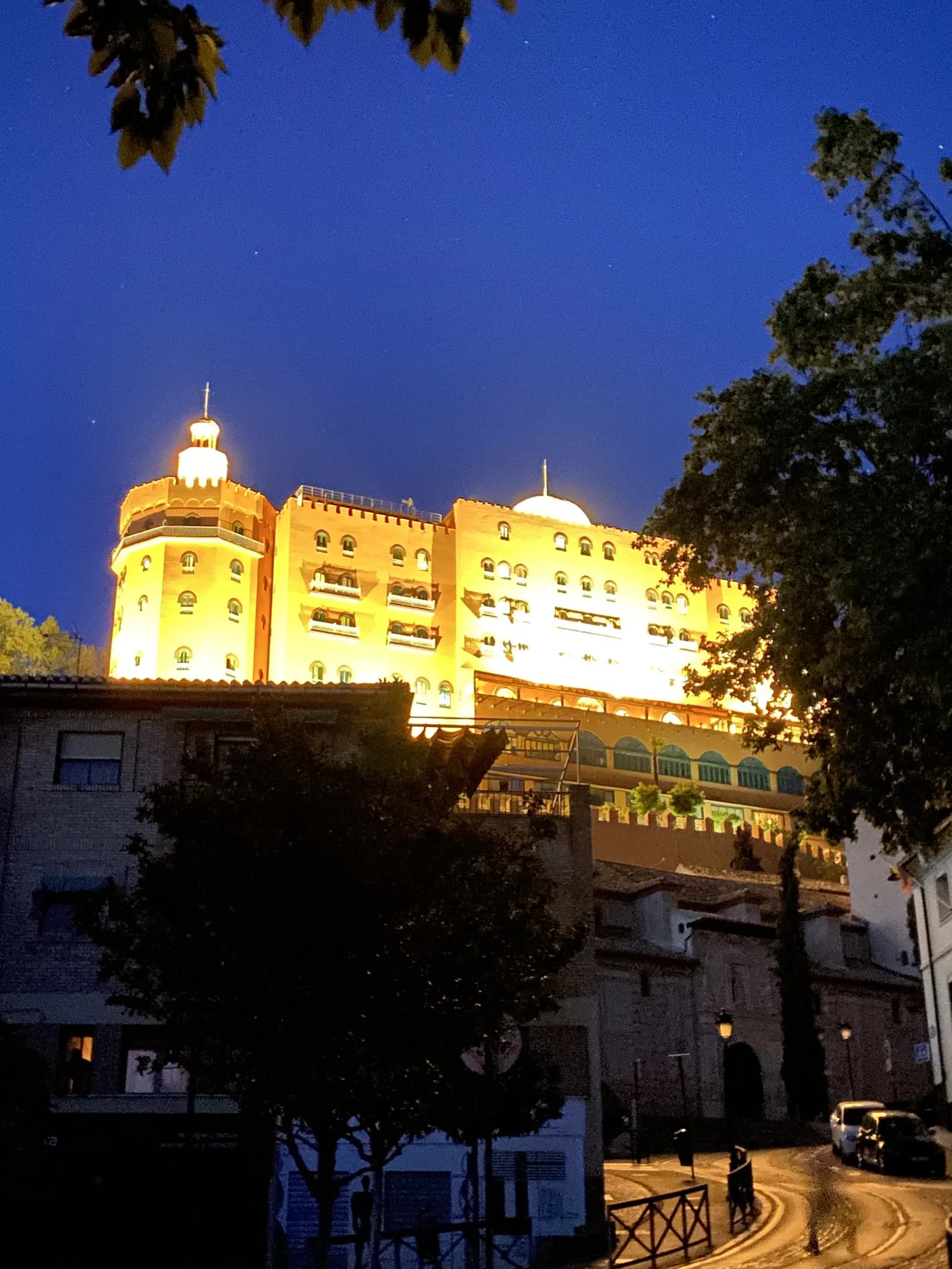
- The video (imperfecto) freezes nothing: it describes, lasts, repeats, decorates: era, comía, llovía, había (it was, I was eating, it was raining, there was). «The sun was setting (atardecía) and the Alhambra turned (se ponía) golden while people chatted (charlaban).» None of those actions has a marked end: they are the scenery.
Pocket rule: if you can add a camera click, it is indefinido. If it is a scene running in the background, it is imperfecto. (PCIC, Gramática 9.1.2, the pretérito indefinido, and 9.1.3, the pretérito imperfecto.)
Finished action vs backdrop
- Single, closed action → indefinido: «Estudié español dos años» (I studied Spanish for two years — it started and ended).
- Habit or routine in the past → imperfecto: «De pequeña estudiaba en Granada cada verano» (As a child I used to study in Granada every summer — it repeated).
- Description (time, place, age, state, feeling) → imperfecto: «Era verano, hacía calor, yo tenía veinte años y estaba feliz» (It was summer, it was hot, I was twenty and I was happy).
- A chain of events that move forward → indefinido: «Llegué, dejé la mochila, bajé a la plaza y pedí una horchata» (I arrived, dropped my bag, went down to the square and ordered a horchata).
A trick: the imperfecto rarely stands alone in a story; it is the bed the indefinido photos land on.
«Cuando» puts the two together
Here is the jewel — and the real test. When a backdrop (imperfecto) meets an action (indefinido) in one sentence:
- Cuando salía de casa, empezó a llover. (As I was leaving home, it started to rain.) — salía (background, in motion) + empezó (photo, interrupts).
- Mientras cenábamos, llamaron a la puerta. (While we were having dinner, someone knocked.)
- Paseaba por el Albaicín cuando la vi. (I was walking through the Albaicín when I saw her.)
The video was running (salía, cenábamos, paseaba) and suddenly —click— the photo drops in (empezó, llamaron, vi). Master this and you have mastered 80% of the contrast.
Verbs that change meaning
A handful of verbs do not just change tense, they change meaning depending on which past you pick. It is subtle, it is very Spanish, and it separates the shaky from the native-sounding:
- Saber: sabía = I had the knowledge («Sabía que venías» — I knew you were coming). supe = I found out, at that moment («Supe la verdad ayer» — I learned the truth yesterday).
- Conocer: conocía = I already knew it («Conocía Granada de antes» — I knew Granada from before). conocí = I met/discovered it for the first time («Conocí a Lorca leyéndolo» — I discovered Lorca by reading him).
- Querer: quería = I intended («Quería ir» — I wanted to go). quise = I actively tried («Quise entrar pero estaba cerrado» — I tried to go in but it was closed); and no quise = I refused.
- Poder: podía = I had the ability. pude = I managed to do it at that moment.
Same word, two stories. It is not a quirk: the indefinido adds the click —the instant something happened— and that turns «to know» into «to find out».
When the error digs in, there is an operating theatre
This contrast is one of those that comes back no matter how much you study the rule, especially if your mother tongue does not split the two pasts. So the Clinic does not hand you another list: it operates. In the indefinido-vs-imperfecto operation you work on one error of yours across three phases —pre-op, operation and review— with hand-curated exercises following the PCIC and instant feedback. No loose theory: the exact intervention on your exact mistake.
Start today, for free
Your first month is free with the code LOS-ESPAÑOLES: the whole Clinic, no card and no commitment.
- Check your starting point with the level test.
- Redeem your free month on the programme.
- And stop hesitating between fui and iba: head to the operating theatre.
Because in Granada the sun was setting (atardecía) slowly while you were deciding (decidías) to come —and the day you arrived (llegaste), the language stopped being an exam and started being life.
Want to learn Spanish like this?
The Clinic turns Granada into your classroom. Start with your diagnosis.
Get started